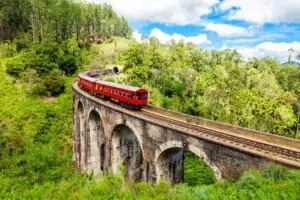
Ella has become one of Sri Lanka’s most photographed hill towns, and it’s easy to see why once you’ve stood on the tracks at Nine Arch Bridge. But there is more to this small hill-country town than the famous shot that fills so many Instagram feeds. Tucked into a fold of the Uva highlands at a gentler elevation than Nuwara Eliya, Ella has a laid-back, backpacker-meets-boutique energy that’s grown up around its scenery rather than replaced it. Here’s how to spend a few days there without missing what matters.
Getting There: The Train Ride Is Part of the Experience
Most visitors arrive by train, and for good reason. The ride from Kandy or Nanu Oya winds through tea estates, tunnels, and misty valleys, unfolding at a pace that no highway drive can match. Windows stay open, tea pickers wave from the slopes, waterfalls appear and vanish around bends, and the air cools noticeably as the train climbs toward the hill country. It’s less a transfer between destinations than a destination in its own right, the kind of journey people build entire trips around.
It is worth booking a reserved seat well ahead during peak months (December to March, and again around April), when demand from both tourists and locals can fill trains days in advance. Second-class observation cars and the newer air-conditioned carriages sell out fastest, sometimes weeks in advance during the busiest weeks. If reserved seats aren’t available, unreserved third class is still an option for the adventurous, though it means standing room only on busy days and, for some travellers, hanging in the doorway for photos, a scene that’s become iconic but is worth doing with real caution.
Whichever class you choose, try to time your journey for daylight; the stretch between Nanu Oya and Ella, past Demodara and the famous Nine Arch Bridge itself, is the scenic highlight of the whole route. Bring a light jacket even in the warmer months; the hill country breeze through an open window has a way of catching people off guard, and keep your camera or phone charged, because this is not a ride where you’ll want to be looking down at a dead screen.
Start Early: Sunrise at Little Adam’s Peak
Once in town, start early. The sunrise hike up Little Adam’s Peak is short enough for most fitness levels, making it one of the more accessible hill-country hikes in Sri Lanka. The walk up takes around 45 minutes to an hour at an easy pace and rewards early risers with clear views before the clouds roll in later in the morning. The path is well marked and passes through tea plantations before a short, steeper final push to the summit, with a few sections of steps and railings near the top for the last scramble.
From the top, the view stretches across the valley toward Ella Rock and, on a clear day, all the way to the coast, a rare moment where you can take in both the hills behind you and a hint of the ocean ahead. It’s a good idea to bring a torch or use your phone’s light for the walk up in the dark, along with a light layer, since the air at that hour is cooler than it feels once the sun clears the ridge.
Because the payoff depends so heavily on visibility, this is one hike where timing matters more than fitness. Aim to be walking by 5:30 am to catch the sunrise itself, or arrive a little later if you’re happy to trade the sunrise colours for a clearer, haze-free view an hour or two after dawn. Either way, allow time to simply sit at the top for a while; it’s one of those views that rewards lingering rather than a quick photo and a walk back down.
Nine Arch Bridge: Timing Is Everything
The Nine Arch Bridge itself is best visited either early morning or late afternoon, both to avoid the midday crowds and to catch the light at its most flattering; the stonework takes on a warm gold cast in the late-day sun that’s very different from the flat light of noon. The bridge, built entirely of stone, brick, and cement, with no steel, is one of the best examples of colonial-era railway engineering still in daily use, and it remains a working section of track rather than a preserved relic. Local legend holds that construction stalled during the First World War when steel shipments were diverted for the war effort, forcing engineers to improvise with local materials instead, part of what makes the structure such an unusual survivor.
If you time it right, you may even catch a train crossing the viaduct, still one of the most photographed moments in Sri Lankan train travel. Train schedules do shift, so it’s worth checking locally on the day rather than relying solely on printed timetables; guesthouse staff and the small cafés near the bridge usually know the latest crossing times. A short walk from the main viewing platform, along the surrounding tea trails, also opens up quieter angles away from the crowds gathered for the classic shot, including a couple of spots slightly above the bridge that give a fuller sense of how it sits within the valley.
Slow Down: What Ella Rewards Beyond the Headline Sights
Beyond the two headline sights, Ella rewards a slower pace. A walk-through a nearby tea estate, with a stop to see how the leaves are plucked, withered, and rolled, adds context to the cup of tea that follows, and most estate visits end with a tasting, which turns an abstract bit of agricultural history into something you can actually taste the difference in. The town’s small cafes, many run by local families, serve everything from Sri Lankan short eats to global comfort food for travellers who’ve been on the road a while, and a fair number have balcony seating angled toward the valley, so even a coffee stop doubles as a view.
An afternoon at one of the viewpoints scattered around town, cup of Ceylon tea in hand and the valley spread out below, often ends up being the memory that lingers longest, quieter than the bridge, but no less Ella. There’s also a small, low-key night market feel to parts of the main street after dark, worth a wander even if you’ve already seen everything on the list.
For those with an extra day, the hike up Ella Rock offers a longer, more demanding alternative to Little Adam’s Peak, with fewer crowds and arguably better views, a half-day round trip that rewards travellers willing to trade an easy sunrise stroll for a proper morning hike. Diyaluma Falls, roughly an hour away, is a worthwhile detour for travellers looking to combine Ella with one of the island’s tallest waterfalls, and the site also has natural rock pools near the top that make for a memorable, if slightly adventurous, swim.
Building Ella into a Longer Sri Lanka Itinerary
Ella works well as a two- to three-night stop on a broader hill country route, often paired with Nuwara Eliya or Kandy before it and the southern coast afterwards, with the train journey itself doubling as a scenic transfer between destinations. It’s a natural pivot point in an itinerary, the place where a trip shifts gears from tea-country cool mornings to coastal heat, and where the pace of travel slows down noticeably, at least for a couple of days.
If you’re planning a Sri Lanka itinerary and want Ella built in properly, rather than rushed through, get in touch, and we’ll help you shape a route that gives it the time it deserves.